You Downloaded An Autounattend.Xml File From The Internet And You Made Some Changes UPDATED
You Downloaded An Autounattend.Xml File From The Internet And You Made Some Changes
When you first a new installation of Windows ten, you must go through the Windows Setup, which is the experience that helps you to configure various settings, including language preferences, production key, and partition layout. Later the installation, you lot likewise have to become through the out-of-box experience (OOBE), which you lot need to consummate to configure settings similar keyboard layout, account, and privacy settings.
Although the process is relatively easy for nearly people, yous still take to spend the fourth dimension controlling the installation and answering questions, which can have up a lot of fourth dimension, especially if you lot need to complete multiple installations in your workplace.
If you want to automate the installation procedure (and save time in the process), you can create an answer file with instructions to complete every on-screen prompt, which you can integrate onto a bootable media. Then the Windows Setup can read to install Windows 10 automatically.
In this Windows 10 guide, we walk yous through the steps to create an autounattend.xml respond file containing all the necessary settings to perform a bones unattended installation of the OS.
How to create unattended Windows x installation media
On Windows x, you can apply many ways to create and prepare an answer file to automate the installation process. This guide outlines the instructions to configure a ".xml" file to perform an unattended installation of Windows 10 Pro 64-scrap on a reckoner with a single bulldoze using Unified Extensible Firmware Interface (UEFI) or Bones Input-Output System (BIOS).
Afterwards setting up the answer file, the process will erase everything on the drive, create and configure the necessary partitions, and install a fresh re-create of Windows 10 with the most basic settings.
Warning: This is a friendly reminder that the installation procedure will completely erase the hard bulldoze of your computer. If you lot have anything important on this device, information technology'southward recommended to brand a total backup of your PC before proceeding.
- Requirements
- How to install Windows System Image Manager
- How to create Windows x respond file project
- How to create Windows 10 respond file
- How to save Windows 10 reply file project
- How to install Windows x with answer file
- How to troubleshoot issues with Windows 10 answer file
Requirements
This guide has quite a few steps, and you'll need a few things to complete the project successfully:
- Windows Assessment and Development Kit (ADK).
- Windows 10 installation files.
- Windows 10 account with ambassador privileges.
- USB flash bulldoze with 8GB of infinite.
- Spare estimator to examination the installation.
How to install Windows System Image Director
Anyone can write an reply file manually. Microsoft offers the Windows System Paradigm Managing director (SIM) console available through the Windows Assessment and Deployment Kit (ADK) to brand information technology easier to create the file to install Windows 10 unattended.
To install the Windows System Paradigm Manager, utilize these steps:
- Download the Windows ADK installer for Windows 10 version 2004.
- Double-click the adksetup.exe file to begin the installation.
-
Select the Install the Windows Cess and Deployment Kit - Windows 10 to this computer option.
 Source: Windows Cardinal
 - Click the Next button.
- Select your privacy setting.
- Click the Next push.
- Click the Accept button to concur to the license agreement.
- Clear all preselected choices.
-
Check only the Deployment Tools package to install the Windows System Paradigm Manager components.
 Source: Windows Central
 - Click the Install button.
- Click the Close button.


One time you lot complete the steps, you can employ the console to create a ".xml" file with the answer to all the questions to automatically install Windows x.
Later the file is created, you can adjust the settings and reuse it for other installations, instead of having to use the Windows Organisation Paradigm Manager tool.
How to create Windows ten answer file projection
Afterwards installing the Windows System Image Manager console, you demand to import the OS installation files onto your device, and set upward the environment to create an answer file.
Import Windows 10 image files
To create an respond file, you need to open a Windows 10 prototype and create a catalog of all the components to automate the installation. Yet, to perform this task, you must get-go import the installation files onto your device.
To import the Windows 10 installation files, apply these steps:
- Open File Explorer.
-
Navigate to the Windows 10 ISO file location.
Quick tip: Alternatively, you tin can also connect the USB flash drive with the installation files. If y'all don't have the files beneath, you tin can observe the steps to use Rufus to download the latest ISO for Windows 10.
-
Right-click the ISO file and select the Mountain pick.
 Source: Windows Fundamental
 - Open the drive with the Windows 10 installation files.
- Click the Select all button from the "Home" tab.
-
Click the Copy push from the "Home" tab.
 Source: Windows Central
 - Navigate to the folder yous want to use to shop the files for the projection.
- Click the New folder push button from the "Habitation" tab.
- Specify a name for the binder – for case, Windows2004.
- Open up the newly created folder.
-
Click the Paste push from the "Habitation" tab.
 Source: Windows Primal


In one case you consummate the steps, the installation files will exist available on your device. Nevertheless, to go along, you lot need to confirm the install.wim file image is present in the "sources" folder. If the ISO was created using the Media Creation Tool, you lot're likely to accept an install.esd, which you won't be able to open because it's encrypted.
If you don't have an .wim paradigm file, you tin get the uncrypted image past downloading the latest Windows ten ISO file from the Windows Insider Programme or MSDN with a subscription.
Catechumen install.esd to install.wim
In the example that yous're stuck with an "install.esd" image, you can apply the DISM control tool to export the paradigm files and create a ".wim" image from a ".esd" file.
To decrypt an install.esd image, apply these steps:
- Open up First.
- Search for PowerShell, correct-click the superlative upshot, and select the Run as administrator choice.
-
Type the post-obit command to place the index number of the edition you want to employ and printing Enter:
dism /Get-WimInfo /WimFile:C:\path\to\folder\sources\install.esdIn the command, make sure to change the path to the sources folder location with the "install.esd" file on your computer.
- Confirm the index number for the edition you desire to deploy. For instance, in the case, select the index number of 6 to extract the files for Windows 10 Pro.
-
Type the following command to create an install.wim file and press Enter:
dism /Export-Image /SourceImageFile:C:\path\to\folder\sources\install.esd /SourceIndex:half dozen /DestinationImageFile:C:\path\to\folder\sources\install.wim /Shrink:Max /CheckIntegrityIn the command, make certain to change the path to the sources folder location with the "install.esd" file on your device. The destination path should be the same as the source.
 Source: Windows Central

Alternatively, you can besides use the Rufus tool to download the Windows x ISO with an "install.wim" file.
Download install.wim using Rufus
To download a Windows 10 ISO file with Rufus, use these steps:
- Open Rufus download page.
-
Under the "Download" section, click the latest release of the tool to save the file on the computer.
 Source: Windows Cardinal
 - Double-click the Rufus-x.x.exe file to launch the tool.
- Under the "Device" section, select the USB flash drive with at least 8GB of space.
-
Nether the "Boot option" section, click the arrow push button next to the "Select" option, and choose the Download selection.
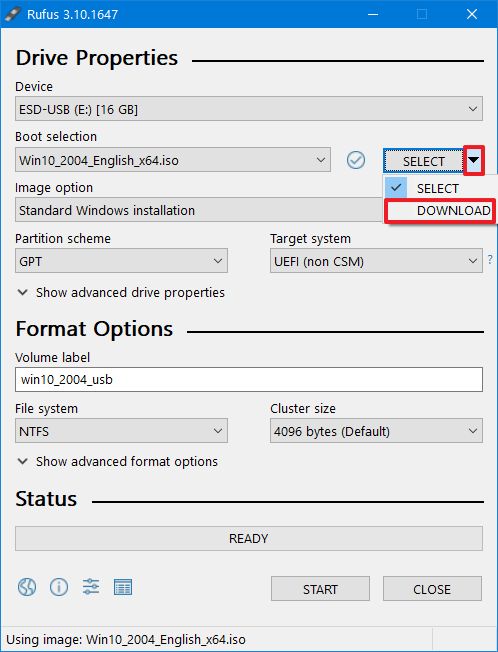 Source: Windows Central
 - Click the now available Download button.
- Use the "Version" drop-downwardly bill of fare and select Windows 10.
- Click the Go along button.
- Select the 20H1 (Build 19041.264 - 2020.05) option to download the Windows 10 May 2020 Update.
- Click the Continue push button.
- Use the "Edition" driblet-down menu and select the Windows 10 Home/Pro option.
- Click the Continue button.
-
Use the "Language" driblet-downwardly card and select your installation language.
Quick note: If you're in the United States, you should select "English" instead of "English International."
- Click the Continue button.
-
Use the "Architecture" drop-down menu and select the 32-flake or 64-bit (recommended).
Quick tip: Y'all can find out the architecture of your device on Settings > System > Near, under Device specifications.
-
Check the Download using a browser pick.
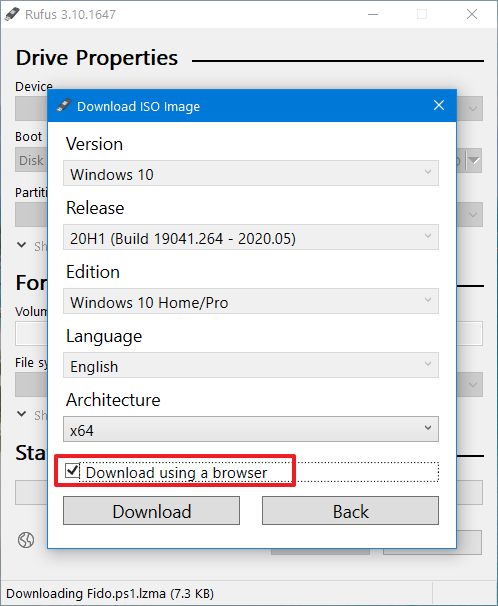 Source: Windows Central
 - Click the Download push.
- Salvage the ISO file on your device.


Once you lot consummate the steps, you'll end up with an ISO file of Windows x that includes the install.wim file within the "sources" folder.
Setting up an answer file surroundings
To set up the surround to create a new answer file project, use these steps:
- Open Kickoff.
- Search for Windows Arrangement Image Manager and click the top upshot to open the panel.
- Click the File card.
-
Select the Select Windows Image pick.
 Source: Windows Fundamental
 - Navigate to the folder with the Windows ten installation files exported.
- Access the source folder.
-
Select the install.wim prototype file.
 Source: Windows Fundamental
 -
Click the Open button.
Important: Make sure that image is an install.wim file. Otherwise, if yous accept an install.esd paradigm, this will non piece of work.
-
Select the edition of Windows 10 yous want to use. (Normally, you want to select the version that you're planning to install.)
 Source: Windows Fundamental
 - Click the OK button.
-
Click the Yes push button to create a new itemize file (if applicable).
Quick note: This procedure will take some time, but information technology's a one-time process. The .clg file will exist saved in the same location where the install.wim is stored, and you tin can reuse it after on other projects.
-
Nether the "Distribution Share" section, right-click on "Select a Distribution Share" and select the Create Distribution Share choice.
 Source: Windows Fundamental
 - Click the Create New Folder selection in the dialog box.
- Specify a name for the folder – for example, "Distribution" and select the folder.
-
Click the Open button.
 Source: Windows Fundamental
 - Click the File menu.
-
Select the Select Distribution Share option.
 Source: Windows Key
 - Locate the folder you recently created for the distribution files.
- Click the Open button.
- Click the File menu.
-
Select the New Respond File pick.
 Source: Windows Central


Subsequently you lot complete the steps, the environment will be created to configure an answer file.
How to create Windows x answer file
An answer file contains 7 different stages (passes), and the stages yous need to configure volition depend upon the blazon of automation yous want to create.
This guide will aid you to get started configuring an autounattend.xml reply file with the minimum requirements to automate the installation of Windows 10 Pro using the 1 windowsPE, four specialize, and 7 oobeSystem stages.
Pass 1 windowsPE
Using the pass "1 windowsPE," yous'll fix upwardly region and language, drive configuration, installation location, and product key.
Quick annotation: Depending on the image, you lot may see the components name starting with amd64_Microsoft-Windows for the 64-scrap version or x86_Microsoft-Windows for the 32-scrap version of Windows 10. For this guide, we'll be using the amd64_Microsoft-Windows name format.
Configure language and region settings
To configure the region and language settings, while in the Windows Arrangement Prototype Manager, use these steps:
- Nether the "Windows Image" section, aggrandize the Components folder.
- Expand the amd64_Microsoft-Windows-International-Core-WinPE component.
-
Right-click the SetupUILanguage component and select the Add Setting to Laissez passer ane windowsPE selection.
 Source: Windows Central
 - Under the "Reply File" department, on the correct side, select the amd64_Microsoft-Windows-International-Cadre-WinPE component.
-
Nether the "Settings" section, on the right side, define the keyboard, region, principal and fall dorsum language, and device location. For example, if yous're located in the U.s.a., yous should be using these settings:
- InputLocale: en-The states.
- SystemLocale: en-Usa.
- UILanguage: en-United states of america.
- UserLocale: en-US.
 Source: Windows Central
 Quick tip: Only users exterior the United states should configure ULLanguageFallback using the en-US value as the fallback language. To identify the correct input profile name, you can bank check out this Microsoft back up page.
- Select the SetupUILanguage sub-component.
-
Under the "Settings" section, on the right side, gear up UILanguage with the correct language. For instance, because we're doing an install in "English," we're using the en-United states option.
 Source: Windows Central


Configure installation settings
Inside the reply file, you too accept to specify the settings to properly configure the drive.
To configure the drive settings in the answer file, use these steps:
- Under the "Windows Image" section, expand the Components folders.
- Aggrandize the amd64_Microsoft-Windows-Setup component.
- Aggrandize the DiskConfiguration component.
-
Right-click the Disk component, and select the Add Setting to Laissez passer 1 windowsPE pick.
 Source: Windows Central
 - Under the "Answer File" department, on the right side, select the DiskConfiguration component.
-
Under the "Settings" section, on the right side, prepare the WillShowUI value to OnError. (If you exit this setting empty, the installation will stop during the hard drive setup process.)
 Source: Windows Central
 - Select the Deejay component.
-
Under the "Settings" section, on the right side, use these values:
- DiskID: 0
- WillWipeDisk: true
 Source: Windows Fundamental
 Quick note: Setting the WillWipeDik setting to true will make sure to erase everything on the get-go hard bulldoze before setting up the partitions. If you have anything of import on this bulldoze, you should fill-in the data before proceeding.


One time you consummate the steps to configure the DiskConfiguration settings, y'all'll need to prepare upwards the division layout, depending on whether your device uses a legacy BIOS or UEFI.
The reason is that BIOS-based computers simply require two partitions (Arrangement Reserved and Windows), and UEFI-based devices require four partitions (WinRE, EFI, MSR, and Windows).
Yous can bank check if you're using BIOS or UEFI past opening Arrangement Information from the Start menu, and checking the "Organization Summary." If "BIOS Manner" reads Legacy, then you're using BIOS; if it reads UEFI, yous're using UEFI.
BIOS simply: Creating and modifying partitions
If you have a computer using the legacy BIOS, continue with these steps. Otherwise, skip this part, and follow the UEFI instructions beneath.
To configure the partition layout for a device using BIOS, apply these steps:
- Under the "Respond File" section, aggrandize the amd64_Microsoft-Windows-Setup component.
- Expand the DiskConfiguration component.
- Expand the Disk component.
-
Right-click the CreatePartitions component, and select the Insert New CreatePartition option to create the showtime sectionalisation.
 Source: Windows Central
 - Right-click CreatePartitions again, and select the Insert New CreatePartition pick to create a second partition.
- Select the first CreatePartition.
-
Under the "Settings" department, on the right side, apply these values to create a system reserved partition:
- Extend: false.
- Order: 1.
- Size: 500.
- Blazon: Main.
 Source: Windows Central
 Using these settings, you're indicating the setup to create the system reserved partition of 500MB, a partition required for Windows to kick.
- Select the second CreatePartition.
-
Under the "Settings" section, on the correct side, use these values to create a partition to install Windows 10:
- Extend: true.
- Lodge: 2.
- Type: Primary.
 Source: Windows Primal
 Using these settings, you're indicating the setup to create a partitioning to install Windows x. You'll also notice that the Size value wasn't specified, and Extend was set to true. This is because nosotros want the Windows Setup to create a partition with all the available space left on the drive later on creating the organization reserved partition.
If you want to create multiple partitions, you need to set the value of Extend to imitation, and enter a value in megabytes in the Size setting. Then the final partition should have Extend set to true without specifying the Size value to bespeak the setup to utilise the remaining available space to create the partition.


Using the in a higher place steps, outlined the steps to carved the partitions. The adjacent steps specify the required file format and division properties.
To specify the format settings in the answer file, apply these steps:
- Nether the "Answer File" section, aggrandize the amd64_Microsoft-Windows-Setup component.
- Expand the DiskConfiguration component.
- Aggrandize the Disk component.
-
Right-click the ModifyPartition component, and select the Insert ModifyPartition option to change the first division.
 Source: Windows Cardinal
 - Right-click ModifyPartition again, and select the Insert ModifyPartition option to modify the second partition.
- Select the first ModifyPartition.
-
Nether the "Settings" section, on the right side, use these values to configure a system reserved partition:
- Active: true.
- Format: NTFS.
- Characterization: System.
- Order: 1.
- PartitionID: ane.
 Source: Windows Fundamental
 - Select the second ModifyPartition.
-
Nether the "Settings" section, on the right side, use these values to configure a partition to install Windows x:
- Format: NTFS.
- Label: Windows.
- Letter: C.
- Social club: 2.
- ProductID: ii.
 Source: Windows Fundamental


In the steps, using the Social club and PartitionID, y'all're specifying how the Windows Setup should configure on each of the two raw partitions we created earlier.
Yous tin can learn more about the partition layout required for a BIOS system in this Microsoft support page.
Equally part of this setup, the last chore is to point the setup where to install Windows 10.
To select the drive to install Windows 10 automatically, utilise these steps:
- Under the "Windows Image" section, aggrandize the Components folders.
- Expand the amd64_Microsoft-Windows-Setup component.
- Expand the ImageInstall component.
- Expand the OSImage.
-
Correct-click the InstalTo component, and select the Add together Setting to Pass 1 windowsPE option.
 Source: Windows Cardinal
 - Under the "Answer File" section, on the right side, select the InstallTo component.
-
Under the "Settings" section, on the right side, use these values:
- DiskID: 0.
- PartitionID: ii.
 Source: Windows Central


The above settings tell the setup to install Windows 10 automatically on the first drive inside the 2d partition.
In one case you consummate the steps, go along with the Defining the product fundamental instructions.
UEFI only: Creating and modifying partitions
If you accept a computer using UEFI, continue with these steps. Otherwise, skip this part, and follow the BIOS instructions outlined in a higher place.
- Under the "Answer File" section, expand the amd64_Microsoft-Windows-Setup component.
- Aggrandize the DiskConfiguration component.
- Expand the Disk component.
-
Right-click the CreatePartitions component, and select the Insert New CreatePartition option to create the beginning partitioning.
 Source: Windows Central
 - Right-click CreatePartitions again, and select the Insert New CreatePartition option to create a second partition.
- Right-click CreatePartitions again, and select the Insert New CreatePartition option to create a tertiary partition.
- Right-click CreatePartitions again, and select the Insert New CreatePartition option to create a fourth sectionalization.
- Select the first CreatePartition.
-
Under the "Settings" section, on the right side, utilize these values to create the Windows Recovery (WinRE) partition:
- Extend: false.
- Guild: one.
- Size: 500.
- Type: Chief.
 Source: Windows Key
 - Select the second CreatePartition.
-
On the right side, nether "Settings," utilise these values to create an EFI partition:
- Extend: simulated.
- Order: two.
- Size: 100.
- Blazon: EFI.
 Source: Windows Central
 - Select the third CreatePartition.
-
On the correct side, under "Settings," use these values to create a Microsoft reserved partition (MSR) division:
- Extend: false.
- Order: 3.
- Size: 16.
- Blazon: MSR.
 Source: Windows Central
 - Select the third CreatePartition.
-
On the right side, under "Settings," use these values to create the Windows partition:
- Extend: true.
- Society: 4.
- Type: Primary.
 Source: Windows Central


Using the above steps, outlined the steps to carved the partitions. The adjacent steps specify the required file format and partition properties.
To specify the format settings in the reply file, use these steps:
- Under the "Answer File" section, aggrandize the amd64_Microsoft-Windows-Setup component.
- Expand the DiskConfiguration component.
- Expand the Disk component.
-
Correct-click the ModifyPartition component, and select the Insert ModifyPartition option to create the offset partition.
 Source: Windows Central
 - Right-click ModifyPartition again, and select the Insert ModifyPartition option to modify the second partition.
- Right-click ModifyPartition once more, and select the Insert ModifyPartition option to modify the tertiary sectionalization.
- Correct-click ModifyPartition once more, and select the Insert ModifyPartition option to alter the quaternary segmentation.
- Select the first ModifyPartition.
-
On the correct side, nether "Settings," utilise these values to configure the Windows Recovery (WinRE) partitioning:
- Format: NTFS.
- Characterization: WinRE.
- Order: 1.
- PartitionID: 1.
- TypeID: DE94BBA4-06D1-4D40-A16A-BFD50179D6AC.
 Source: Windows Central
 - Select the second ModifyPartition.
-
On the right side, under "Settings," apply these values to configure an EFI partition:
- Format: FAT32.
- Label: System.
- Gild: 2.
- PartitionID: ii.
 Source: Windows Cardinal
 - Select the third ModifyPartition.
-
On the right side, under "Settings," use only these two values to configure a Microsoft reserved sectionalization (MSR) partition:
- Order: three.
- PartitionID: three.
 Source: Windows Central
 - Select the third ModifyPartition.
-
On the right side, under "Settings," apply these values to configure a sectionalisation to install Windows 10:
- Format: NTFS.
- Label: Windows.
- Letter: C.
- Order: 4.
- PartitionID: iv.
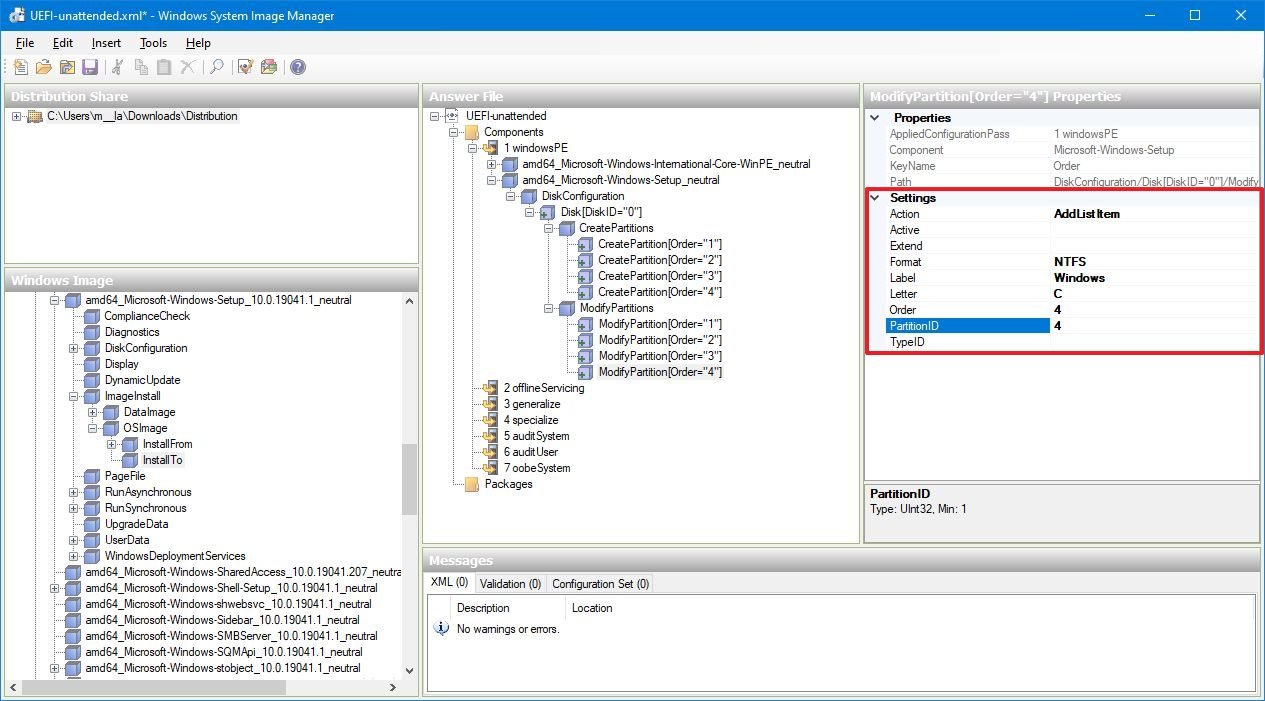 Source: Windows Fundamental


In the steps, using the Order and PartitionID, yous're specifying how the setup should configure each of the iv raw partitions yous accept created earlier.
Yous tin learn more about the division layout required for a UEFI system in this Microsoft back up folio.
Every bit part of this part of the setup, the final chore is to indicate the setup where to install Windows ten.
To select the drive to install Windows 10 automatically, use these steps:
- Under "Windows Prototype," aggrandize the Components folders.
- Expand the amd64_Microsoft-Windows-Setup component.
- Expand the ImageInstall component.
- Aggrandize the OSImage component.
- Right-click the InstalTo component, and select the Add Setting to Pass 1 windowsPE selection.
- Nether the "Answer File" section, on the right side, select the InstallTo component.
-
Nether the "Settings" section, on the right side, apply these values:
- DiskID: 0.
- PartitionID: four.
 Source: Windows Key

The higher up settings will indicate for the setup to install Windows ten on the commencement drive inside the fourth partition.
One time you complete the steps, continue with the Defining the product key instructions beneath.
Defining the product key
In the first laissez passer, you can too specify the product fundamental for Windows x. If y'all're creating an respond file that yous'll employ in multiple devices, y'all should exist using a book or generic production key.
To specify a product key, use these steps:
- Under the "Windows Image" component, aggrandize the Components folders.
- Expand the amd64_Microsoft-Windows-Setup component.
- Expand the UserData component.
-
Right-click the ProductKey component and select the Add Setting to Pass 1 windowsPE option.
 Source: Windows Cardinal
 - Under the "Answer File" section, on the right side, select the UserData component.
-
Under the "Settings" section, on the right side, apply the following settings:
- AcceptEula: true.
- Arrangement: WC.
 Source: Windows Cardinal
 In the to a higher place settings, you can utilise any name for the Organization value. For case, abode users could "Family unit" as the system proper name.
- Expand the UserData component.
- Select the ProductKey component.
-
Under the "Settings" section, make sure to update the Cardinal value using the product fundamental for the edition of Windows 10 you intend to install.
 Source: Windows Central


You can also employ a generic production key to create an answer file:
- Windows x Pro: VK7JG-NPHTM-C97JM-9MPGT-3V66T.
- Windows 10 Dwelling house: YTMG3-N6DKC-DKB77-7M9GH-8HVX7.
- Windows ten Enterprise: NPPR9-FWDCX-D2C8J-H872K-2YT43.
You tin always check this Microsoft back up website to find the advisable generic central for your installation.
Laissez passer 4 specialize
If you want to configure additional settings, such equally model, manufacturer, computer proper name, ownership name, timezone, and more during the installation, while in the Windows Organisation Image Manager, employ these steps:
- Under the "Windows Image" department, expand the Components folders.
- Expand the amd64_Microsoft-Shell-Setup component.
-
Right-click the OEMInformation component and select the Add Setting to Pass iv specialize choice.
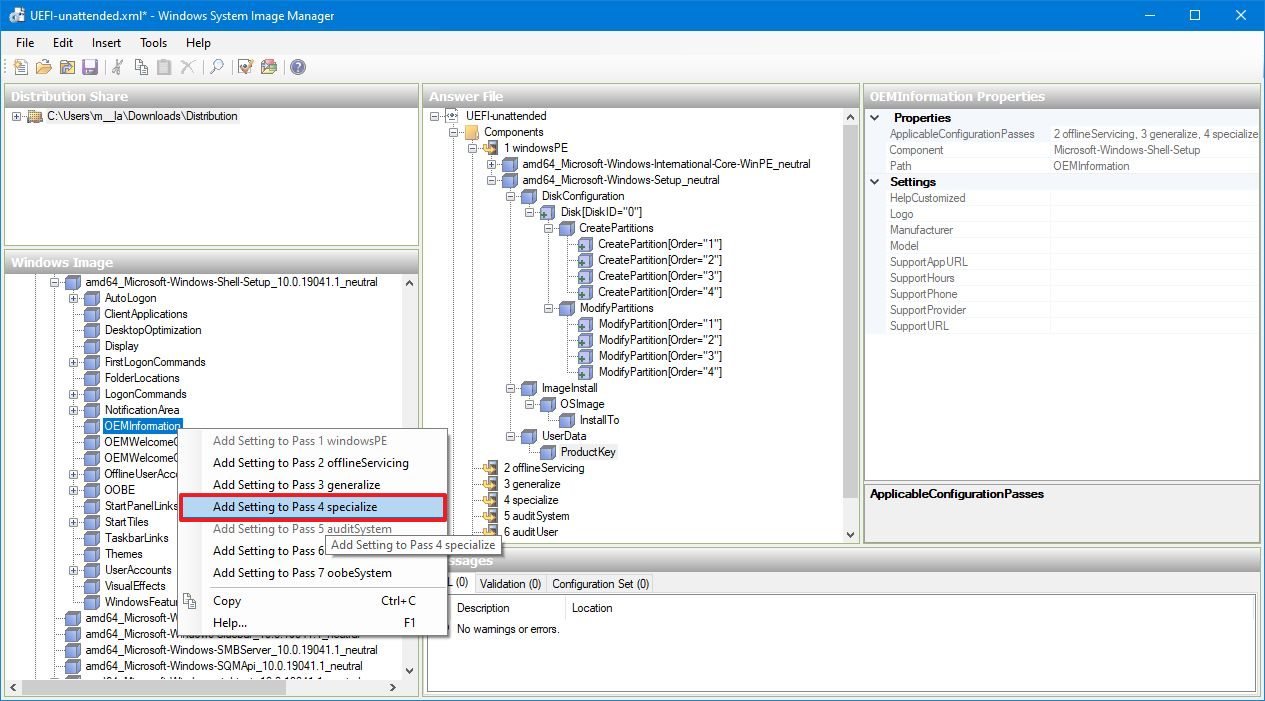 Source: Windows Central
 - Under the "Answer File" section, on the right-side, select the amd64_Microsoft-Beat-Setup component.
-
Under the "Settings" section, on the right side, utilise the post-obit values (specifying your custom information):
- ComputerName: Workstation.
- CopyProfile: true.
- RegisteredOrganization: Windows Central.
- RegisteredOwner: WC.
-
TimeZone: Eastern Standard Time.
 Source: Windows Key
If you don't configure the TimeZone setting, Windows 10 volition set the zone based on the language you lot're installing. Yous can check the Microsoft support website to find out the exact proper name for your time zone.
-
Expand the amd64_Microsoft-Beat-Setup component.
- Select the OEMInformation component.
-
(Optional) Under the "Settings" section, on the correct side, specify some figurer specific properties:
- Manufacturer: Dell.
- Model: XPS.
 Source: Windows Central


Once you consummate the steps, during the installation, the setup will read the autounattend.xml file and configure the settings y'all specified.
Pass 7 oobeSystem
Using an reply file, you lot tin can besides automate the configuration of the out-of-box experience (OOBE), including additional linguistic communication settings, accept the licensing agreement, create a user account, and more.
To configure the out-of-box experience, while in the Windows System Image Director, apply these steps:
- Nether "Windows Image," expand the Components folders.
-
Right-click the amd64_Microsoft-Windows-International-Core component, and select the Add together Setting to Pass seven oobeSystem choice.
 Source: Windows Central
 - Under the "Windows Prototype" department, expand the amd64_Microsoft-Shell-Setup component.
-
Right-click the OOBE component, and select the Add Setting to Laissez passer 7 oobeSystem selection.
 Source: Windows Central
 - Expand the UserAccounts component.
- Expand the LocalAccounts component.
-
Right-click the LocalAccounts component, and select the Add Setting to Pass vii oobeSystem option.
 Source: Windows Cardinal
 - Under the "Answer File" section, select the amd64_Microsoft-Windows-International-Core component.
-
Under the "Settings" section, on the correct-side, specify the language settings:
- InputLocale: en-United states.
- SystemLocale: en-Us.
- UILanguage: en-US.
- UserLocale: en-United states of america.
 Source: Windows Central
 Only users outside the United States should configure ULLanguageFallback using the en-US value every bit the fallback linguistic communication.
To identify the right input profile name, you can bank check out this Microsoft support page.
- Under the "Answer File" section, expand the amd64_Microsoft-Shell-Setup component.
- Select the OOBE component.
- Nether the "Settings" section, on the right size, use the following values:


- HideEULAPage: true.*
- HideOEMRegistrationScreen: true.
- HideOnlineAccountScreens: truthful.
- HideWirelessSetupinOOBE: true.
-
ProtectYourPC: 1.
 Source: Windows Central
 While most settings are self-explanatory, you'll notice that the ProtectYourPC setting is also configured to define how the express settings should be handled. Using the value of i, you're telling the setup to enable the express settings using the default preferences.
- Expand the UserAccounts component.
- Right-click the LocalAccounts component and select the Insert New LocalAccount choice.
- Under the "Settings" section, on the correct side, use the following configuration to create a chief local business relationship:
- Description: My principal local business relationship.
- DisplayName: admin.
- Group: Administrators.
- Proper noun: John.
 Source: Windows Central
 Using the above settings, you'll exist creating an account called "admin" for user "John," and we're calculation the account to the "Administrators" grouping that gives the user unrestricted access to the device. Of class, you tin always define your custom preferences, including for "Clarification," "DisplayName," "Group," and "Name."
- Expand the LocalAccount component.
- Select the Password component.
- Under the "Settings" department, on the correct-side, blazon a password in the Value field.
 Source: Windows Key


While you lot'll see the password in plain text, after saving the autounattend.xml file, the value volition be encrypted.
How to relieve Windows 10 answer file projection
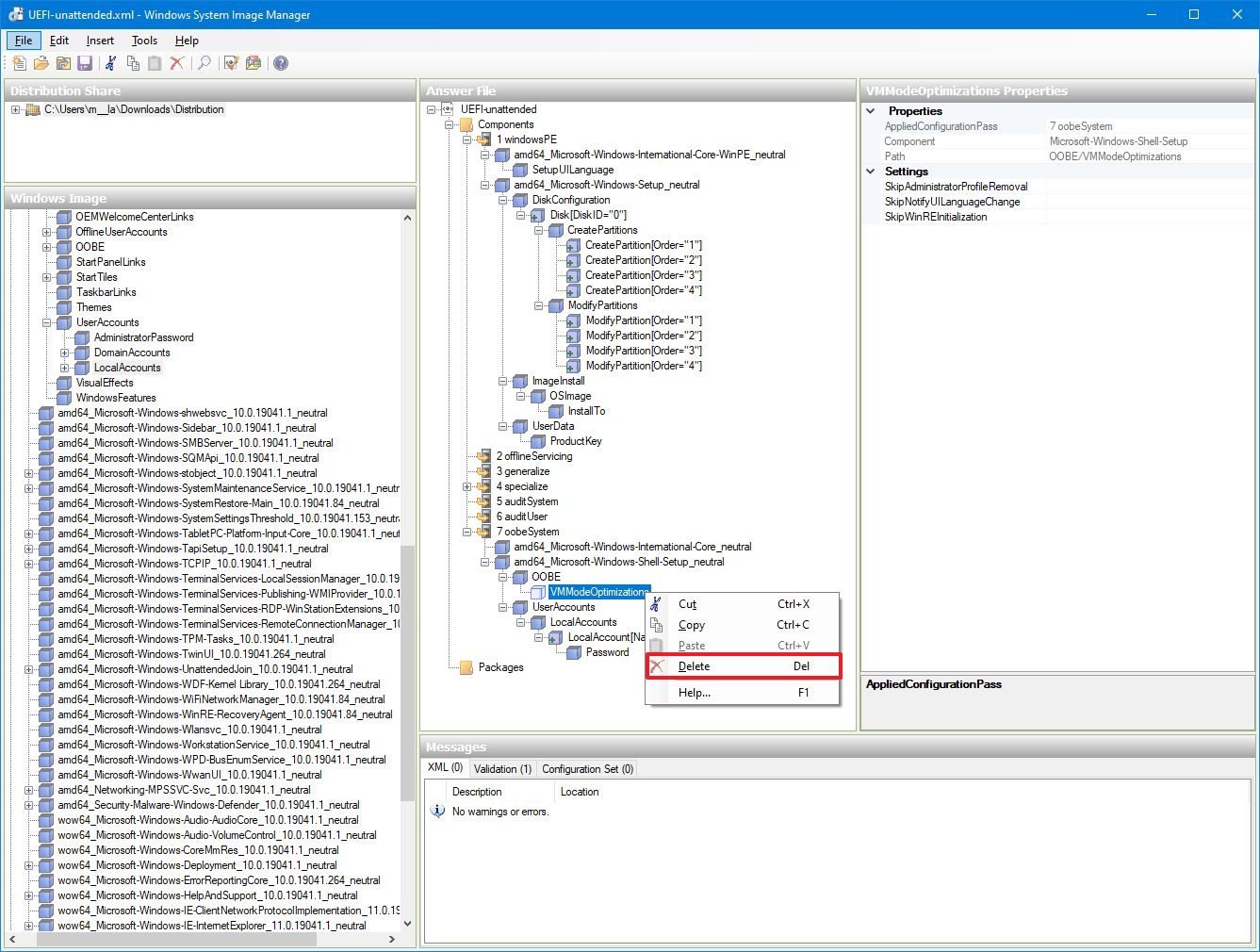
Once you complete setting up all the configurations to install Windows 10 automatically, you need to remove all the unmodified components, validate the answer file, and save changes as an autounattend.xml file.
Remove unmodified components
To remove unnecessary components, use these steps:
- Under the "Reply File" department, aggrandize all the components you added from the "Windows Paradigm" section.
- Select the component that you didn't configure. (These are those with low-cal purple color.)
-
Right-click the components, and select the Delete option.
 Source: Windows Fundamental
 - Echo steps No. two and 3 until you remove all the components that you didn't modify.

After y'all complete the steps, you need to validate the reply file.
Validating respond files
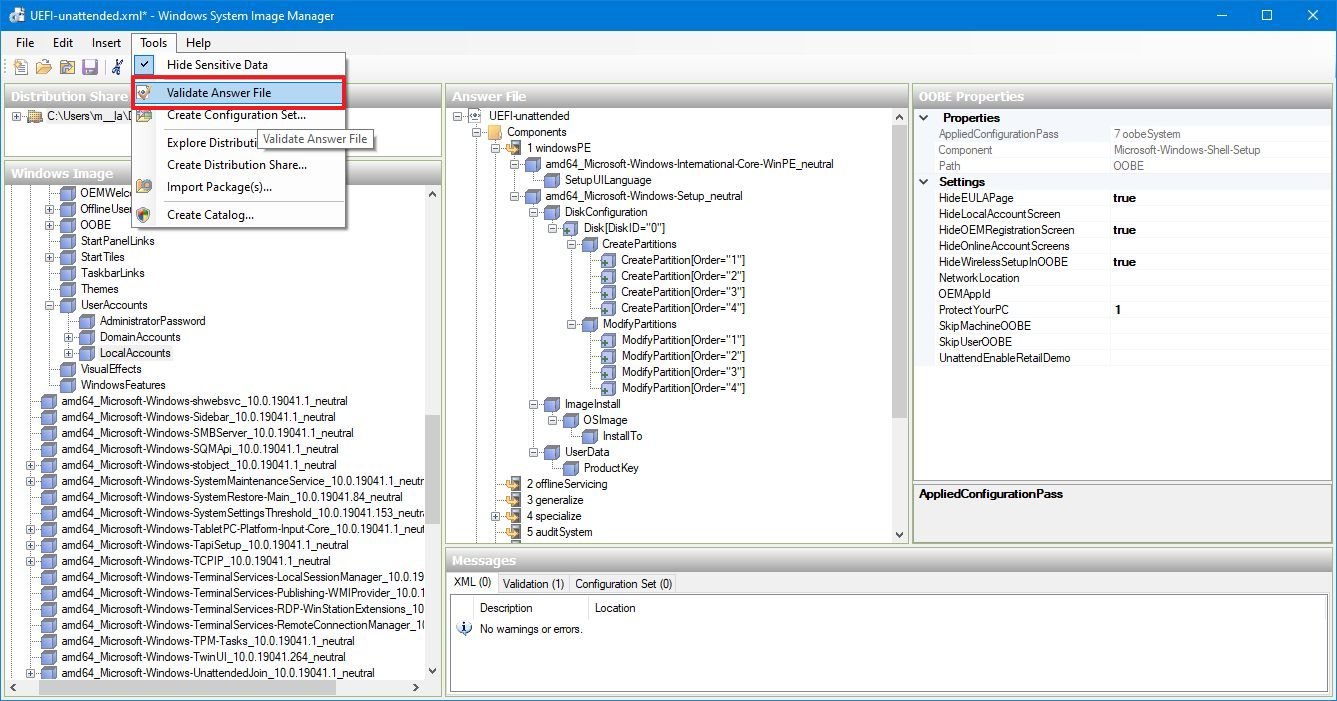
To validate the respond file, use these steps:
- Click the Tools menu.
- Select the Validate option.
-
Nether the "Messages" section, at the lesser, check the Validation tab. If you don't see any warnings, the file is skilful to become.
 Source: Windows Central

Once you lot complete the steps, it's fourth dimension to save the file and imported to the installation media.
Saving the respond file
To save the respond file, employ these steps:
- Click the File menu.
- Select the Salve Answer File As selection.
- Navigate to the binder you desire to salvage the file.
-
Under "File name," use the autounattend.xml file proper noun.
 Source: Windows Cardinal
 - Click the Save button.

If you're configuring multiple answer files, information technology'll exist all-time to save the file on a different folder with a descriptive name.
Import reply file to USB media
To include an autounattend.xml file on a Windows 10 bootable media, use these steps:
- Open up File Explorer.
- Navigate to the autounattend.xml file location.
-
Right-click the file, and select the Copy option.
 Source: Windows Central
 - Open the USB media with the Windows 10 installation files.
-
In the root of the drive, right-click the Paste to re-create the autounattend.xml to the Windows 10 installation media.
 Source: Windows Central
 Quick tip: When placing the "autounattend.xml" file on the installation media, make certain you're using a bootable media that simply includes one architecture (in this example, Windows ten 64-bit). If y'all created an installation media for both 32-bit and 64-bit, the process would intermission at the beginning until you select the architecture to install.


In the example that you don't accept a Windows 10 USB installation media, y'all can create one using the Media Creation Tool or using a third-party tool, such as Rufus.
How to install Windows 10 using reply file
Once yous have the USB bootable media with the respond file incorporated, yous can perform an unattended installation of Windows ten with these steps:
Alarm: This procedure volition delete everything on your estimator and install Windows 10 without any prompts. Make sure to connect the USB flash drive to the correct device. Otherwise, you lot may end up wiping out the wrong device.
- Plough off the computer you lot desire to install Windows 10.
- Connect the USB wink bootable media with the autounattend.xml file.
- Power on the computer and and so Windows ten should install automatically.
If the Windows Setup doesn't first, it's likely because you don't take the device configured to kicking from the USB installation media. If this is the example, you'll need to admission the BIOS or UEFI firmware on your motherboard to change the kick order.
This process typically requires hitting one of the office keys (F1, F2, F3, F10, or F12), the ESC, or Delete cardinal as soon every bit yous kickoff your device. Still, these settings will be unlike per manufacturer, and even per device model. Brand sure to cheque your computer manufacturer's support website for more than specific instructions.
Afterwards getting access to the firmware interface, detect the Boot settings and modify the boot lodge to start with the USB drive that includes the installation files, and relieve the settings (unremarkably using the F10 central).
If your reckoner is based on UEFI, then the steps to modify the kick order will be different.
On a Windows 10 device using UEFI, you'll demand to access to Settings > Update & Security > Recovery, and under "Advanced Startup," click the Restart now push button.
Then click on Troubleshoot > Advanced options > UEFI Firmware Settings, and click the Restart button.
One time you're in the UEFI firmware interface, find the Kicking settings and change the boot social club to start with the USB drive that includes the installation files, and then save the settings.
If the drive doesn't have an OS already installed, check your manufacturer support website for details to access the UEFI firmware.
How to troubleshoot Windows 10 answer file
Although an answer file can make the process of installing Windows 10 easier, one pocket-sized mistake tin can halt the setup and cause unwanted errors.
When validating the answer file, if you come up across any bug, yous should e'er re-check the settings for each component you selected and remove whatsoever additional element that was non modified.
If you made a mistake configuring a property value for a component, don't empty the field, instead right-click the property and select the Revert Change option.
At the time to begin the Windows 10 installation, disconnect the computer from the network, because sometimes you may come across problems while the setup is trying to download updates. You can e'er reconnect to the network after the installation.
An reply file explicitly crafted for a computer using a legacy BIOS will not piece of work on a UEFI-based device. E'er make sure to use the right settings for the hardware y'all're trying to automate the installation process.
In the rare case that the answer file you created using Windows System Image Manager isn't working, so you should open the "autounattend.xml" file with whatever text editor and correct any mistake manually.
Anyone can use this automation process, just this method has been designed for organizations. This means that you won't find an option to perform an installation using a Microsoft account. Withal, you can always create an installation with a Windows 10 local account and so link it to your Microsoft account. Yous tin can perform this task from Settings > Accounts > Your info, and clicking the Sign in with your Microsoft account instead link.
You tin can cheque out this Microsoft back up website to learn more about each setting, which you can configure to create an answer file to perform an automated installation of Windows 10.
Wrapping things upwardly
While creating a bootable media with the instructions to install Windows ten automatically has a lot of steps, the automation process will save y'all a significant amount of time and hassle, especially when you're in a network environment where you need to setup Windows 10 on multiple machines.
We're focusing on the minimum steps to perform an unattended clean installation of Windows 10 to assistance go started with the process. It's upward to yous to dig through and configure the components you need to comply with your situation. Furthermore, depending on your installation requirements, you may need to create multiple respond files.
More Windows 10 resource
For more helpful articles, coverage, and answers to common questions most Windows 10, visit the following resources:
- Windows 10 on Windows Cardinal – All you need to know
- Windows x aid, tips, and tricks
- Windows 10 forums on Windows Central
We may earn a commission for purchases using our links. Learn more.

seizing the means of production
Tiny Tina's Wonderlands offers archetype Borderlands action
Gearbox recently gave united states of america the opportunity to go easily-on with Tiny Tina'due south Wonderlands ahead of its release, and fans of the franchise should have no worries. From what little was available to play, information technology's the same Borderlands that people know and love with some fantastic additions.
DOWNLOAD HERE
Posted by: canupdindor.blogspot.com

Post a Comment for "You Downloaded An Autounattend.Xml File From The Internet And You Made Some Changes UPDATED"